
оставить сообщение
Если вас заинтересовала наша продукция и вы хотите узнать больше подробностей, пожалуйста,
Оставьте здесь сообщение, мы ответим вам как можно скорее.


I. Project Overview
Project Background
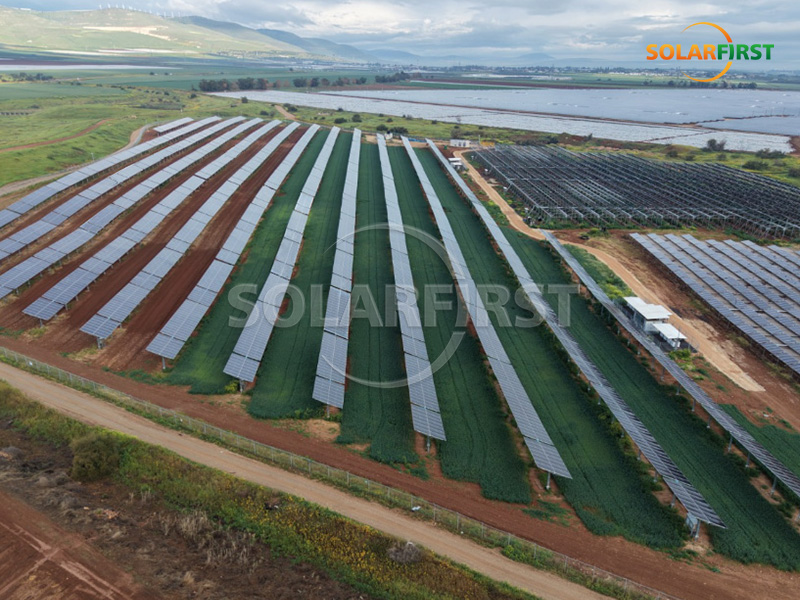
This project is located in Israel, with an installed capacity of 4.5 MWp and a horizontal single-axis tracker (HSAT) system. Construction is scheduled from July 2025 to March 2026. Positioned as a typical “PV + Agriculture” horizontal single-axis tracking application, the project enables the shared use of land for solar power generation and wheat cultivation without occupying arable land, aligning with Israel’s philosophy of efficient land use.
Project Requirements
The client’s core requirements include:
(1)The tracker layout must reserve space for agricultural cultivation and enable synergy between power generation and agriculture;
(2)The tracker power supply and communication must meet local regulatory requirements for safety and reliability, without relying on the PV array or the national grid and without wireless communication;
(3)The foundation type and structural design must adapt to site conditions and ensure long-term stable operation of the tracker system.
II. Project Challenges
Agri-PV Synergy Challenge under Land Resource Constraints
Israel has limited arable land resources, so the project must preserve agricultural cultivation functions while generating electricity. If trackers are laid out too densely, they will crowd crop growth space and affect agricultural machinery access and light availability. How to achieve the dual goals of “power generation + cultivation” on limited land is the core challenge of layout design.
Stringent Local Regulations on System Independence and Reliability
Israel has clear specifications for tracker power supply and communication: power must not be drawn from the PV array or the national grid, and communication must not rely on wireless methods such as WiFi. This means the project must be equipped with an independent power supply system and adopt wired communication, and the overall solution must pass safety and reliability validation.
Adaptation Challenge of Tracker Foundations and Structures in Agricultural Environments
All-steel trackers must operate long-term in an agricultural cultivation environment. The foundation type must ensure load-bearing stability while minimizing impact on the topsoil. Tracker spacing and mounting height must also balance wheat cultivation, field operations, and equipment maintenance, placing high requirements on overall structural compatibility.
III. Solutions
Agri-PV Layout: All-Steel Trackers + Steel Pile Foundations + Wide Spacing
The project adopts all-steel horizontal single-axis trackers with steel pile foundations. A relatively large spacing is set between tracker rows, and wheat is planted in the inter-row areas. This layout ensures normal tracker operation while reserving space for crop growth and agricultural operations, enabling land sharing between PV generation and wheat cultivation.
Independent Power Supply and Wired Communication: Meeting Local Regulatory Requirements
The tracking system is powered by an independent system built by the client; it does not draw power from the PV array or the national grid. Communication is strictly conducted via wired means, without the use of wireless communication such as Wi-Fi. This design ensures the system’s independence and reliability in both power supply and communication, meeting with local Israeli regulations regarding safety and reliability.
Structural and Foundation Adaptation: Balancing Stability and Agricultural Friendliness
The combination of all-steel trackers and steel pile foundations is simple in structure and reliable in load bearing. Steel pile foundations adapt to site conditions, reduce large-scale earthworks, and minimize impact on agricultural cultivation. The overall solution coordinates the tracker system and crop cultivation at a 4.5 MWp capacity.
IV. Project Value
Agri-PV Synergy Unlocks Composite Land-Use Value
Project construction is proceeding steadily according to the schedule from July 2025 to March 2026. Upon completion, the 4.5 MWp single-axis tracking system will generate clean electricity without occupying arable land, while wheat cultivation in the central area will enable multi-purpose land use, creating dual benefits of “power generation + agriculture” and providing a model for efficient land utilization in regions with scarce land resources.
Compliant Design Creates Value for Demonstration and Promotion
Featuring targeted designs such as independent power supply, wired communication, and steel pile foundations, the project meets Israeli technical specifications and regulatory requirements, providing a practical engineering model for local “PV + agriculture” single-axis tracking applications. By spacing out trackers to create room for crops and ensuring reliable tracking, power supply, and communication through an independent system, the project serves as a valuable reference for regions with strict regulations and limited land resources.

 en
 fr
 de
 zh-CN
 ru
 es
 pt
 ja
 ko
 ar